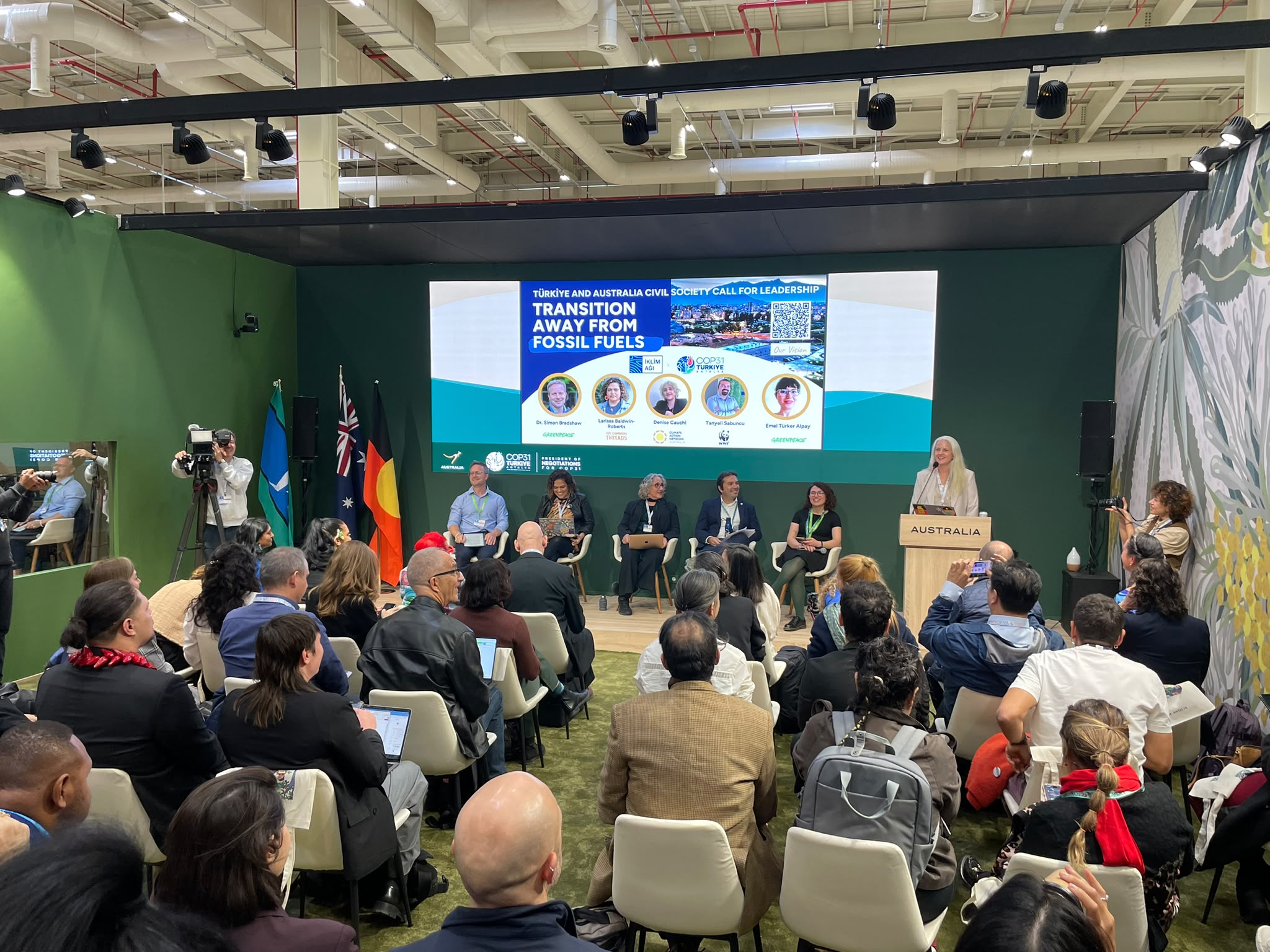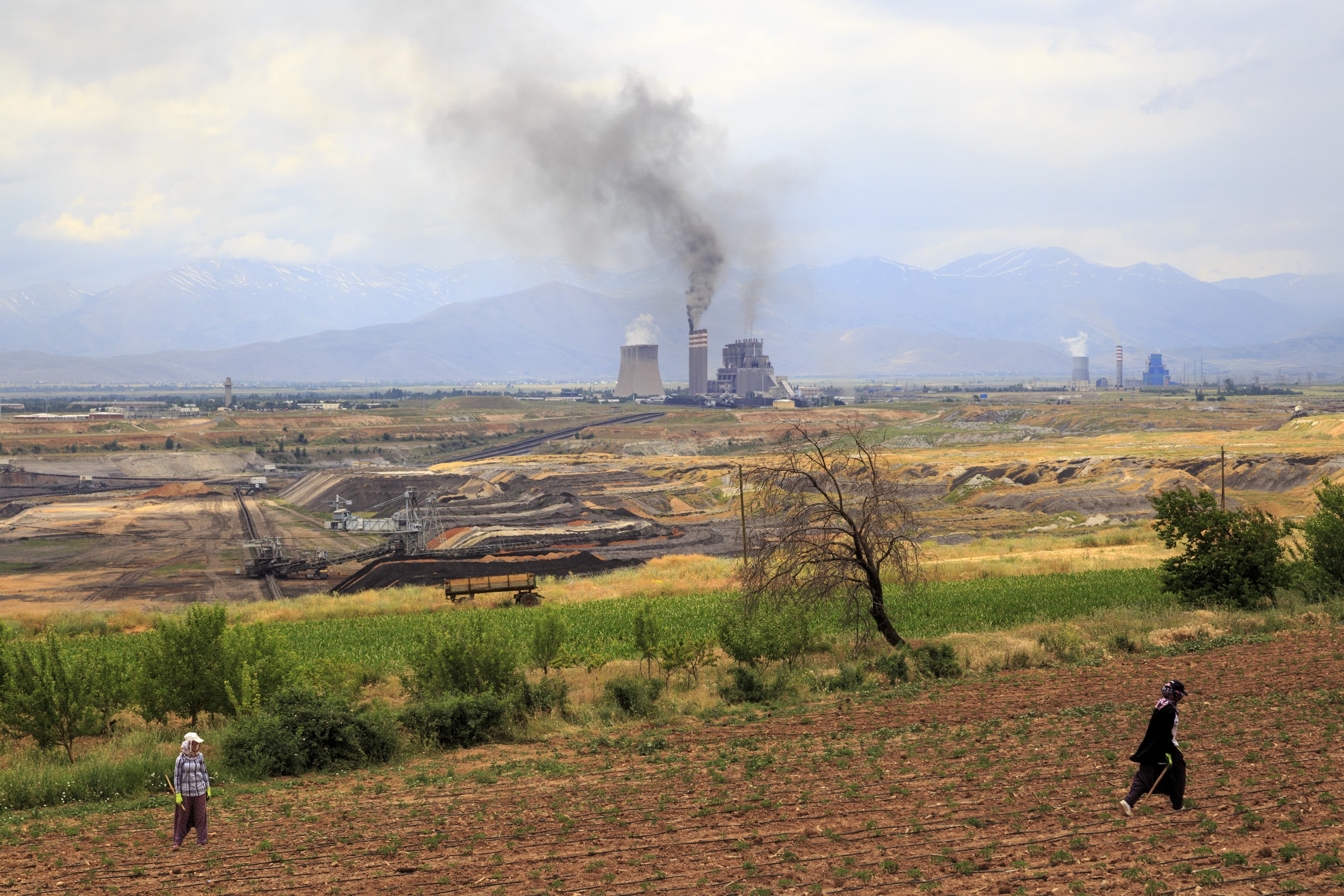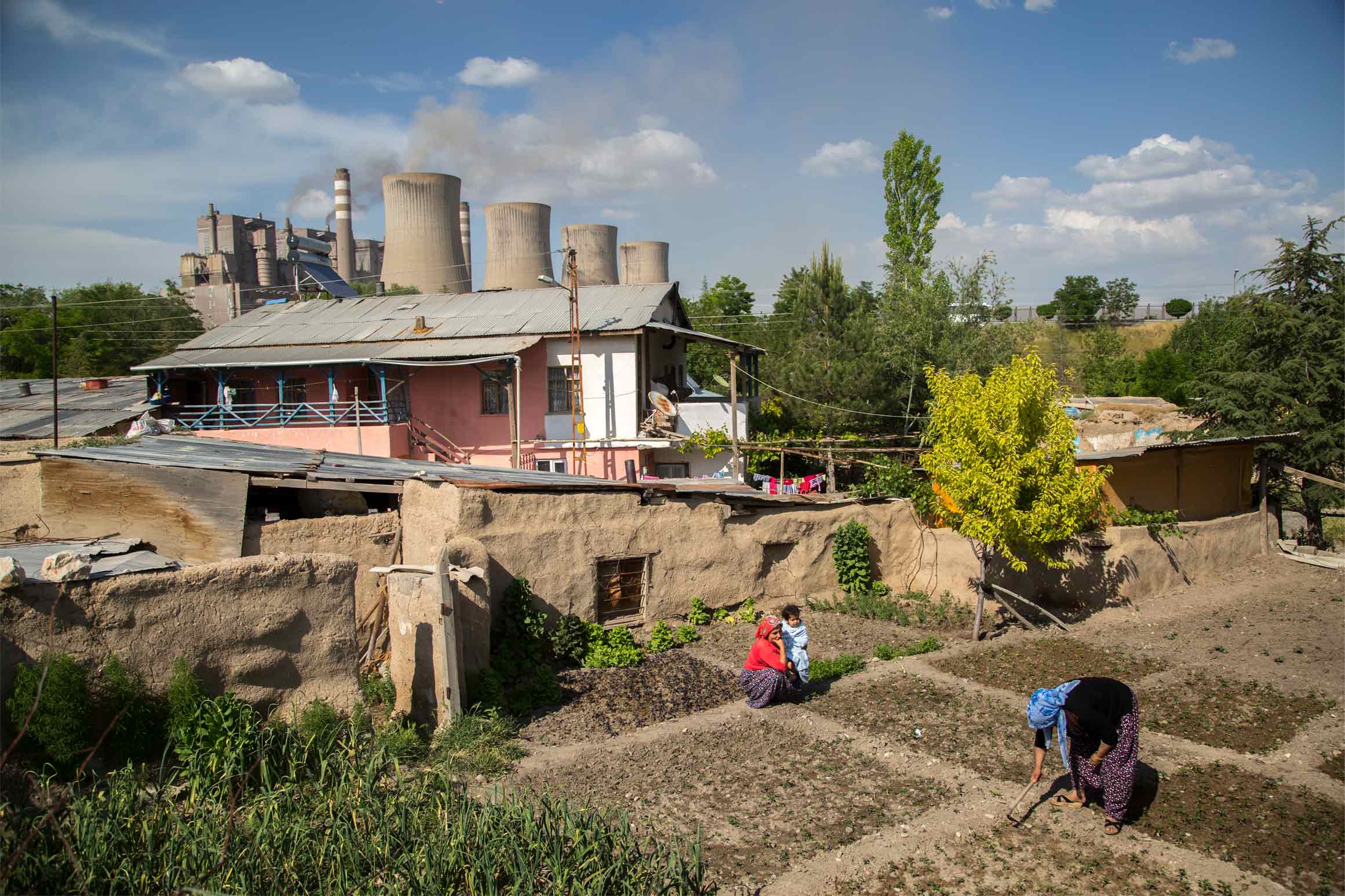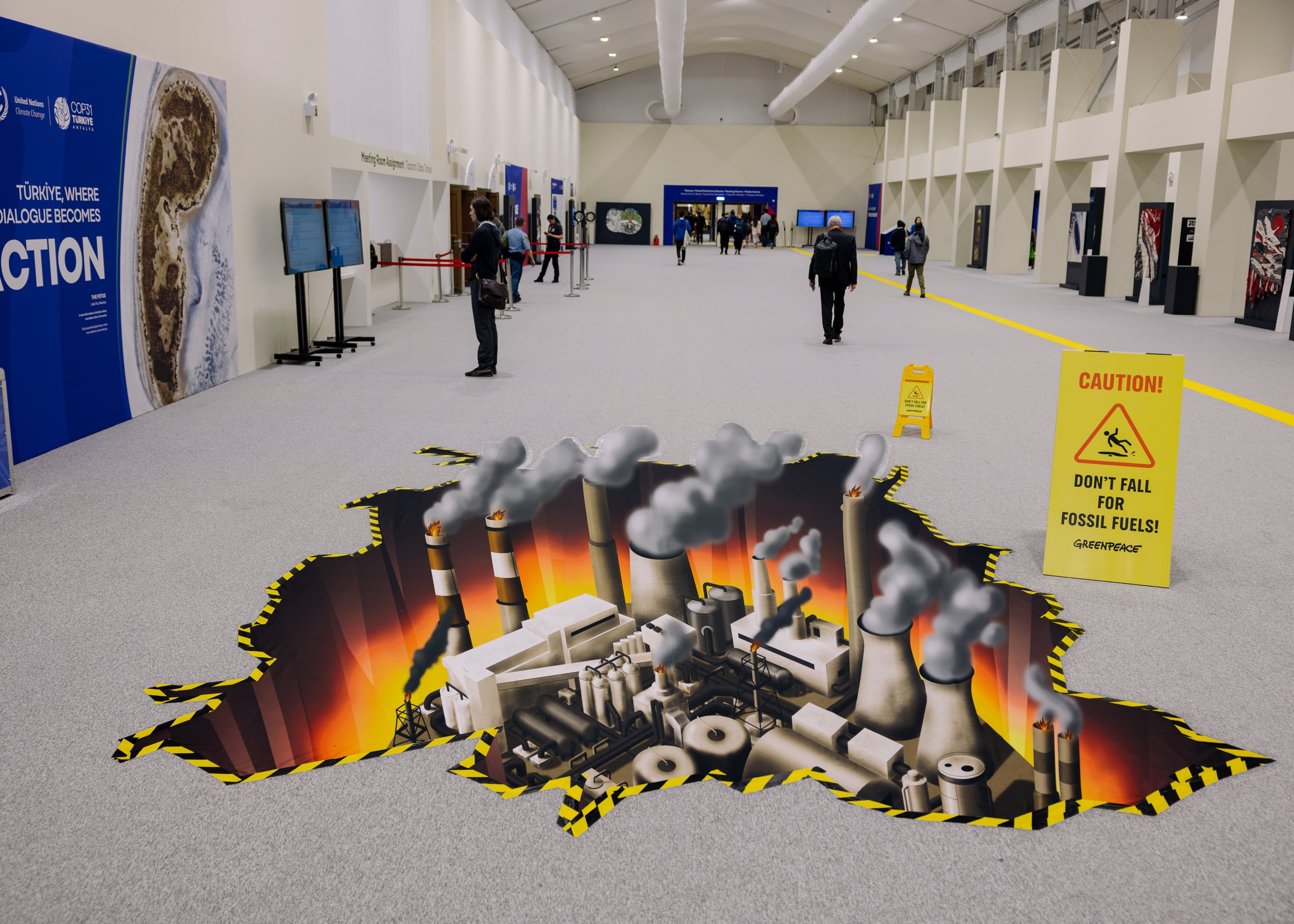
23 November 2026, Antalya – Climate Network Türkiye considers the failure to adopt a strong outcome document, following Türkiye and Australia’s inability to demonstrate the political leadership needed to reach consensus on phasing out fossil fuels, a historic missed opportunity for global climate leadership at COP31.
The Climate Network Türkiye highlighted that the reluctance of Global North countries to take concrete action, coupled with oil-producing countries’ insistence on solutions that have not been proven effective and that delay climate action, rather than committing to a phase-out of fossil fuels, were the main factors preventing consensus from being reached at COP31.
Climate Network Türkiye also noted that, beyond the outcome document, no significant concrete progress was made on operationalising the Just Transition Mechanism or on adaptation finance.
Emphasising the importance of civil society, which has been fighting for climate justice both at the negotiating tables and on the streets, Climate Network Türkiye underlined that progress on climate action depends not only on Türkiye fulfilling its responsibilities as COP31 Presidency through to COP32, but also on the continued determination of collective social movements.
Statements from Climate Network Türkiye members
Yağız Eren Abanus, Climate Justice Programme Coordinator at Mekanda Adalet Derneği (Spatial Justice Association):
“COP31 failed to deliver concrete progress on any of the fundamental issues, including just transition, finance and adaptation, due to developed countries’ delaying tactics and unwillingness to provide finance, aggressive obstruction by fossil fuel-producing countries, and the Presidencies’ inadequate preparation and inability to overcome the deadlock. The draft umbrella decision also weakened the process by diverting the focus of negotiations through its problematic language. We tried to highlight the transformative leadership Türkiye could have demonstrated to prevent this outcome, but the space for participation in climate policymaking was so restricted that we could not make our voices heard. Had civil society been included in decision-making processes to the same extent as corporations were given space at the COP venue, we might be discussing a very different outcome today. Nevertheless, we cannot abandon these spaces and leave them to fossil fuel lobbyists. We will continue our struggle for climate justice and adaptation on the road to COP32, and keep pushing for meaningful participation channels to ensure that the Presidency makes up for this failure.”
Tanyeli Sabuncu, Senior Climate and Energy Advisor at WWF-Türkiye:
“Ignoring the decisions made to date and continuing our dependence on fossil fuels puts the future of our planet and all life at risk. Yet it is possible to transition to renewable energy systems that are accessible to everyone while also improving the well-being of workers and local communities. The Just Transition Mechanism, expected to be operationalised at COP31, was intended to support this transformation by strengthening international cooperation. However, leaders postponed concrete decisions for another year on fundamental issues such as the mechanism’s functions and operating procedures. Our climate and our future cannot afford to wait any longer. Türkiye, whose COP31 Presidency will continue until next year, has a responsibility to demonstrate exemplary policies and provide leadership that builds consensus in this area.”
Özlem Altıparmak, Director of HUDOTO – Law, Nature and Society Foundation:
“For two weeks, we followed the umbrella decision through draft after draft, from midnight sessions to morning texts. In the end, the decision presented as the Antalya Pact was not adopted by the Plenary. This text, which made no mention whatsoever of phasing out fossil fuels, promoted carbon capture technologies as a solution and contained not a single reference to human rights. The language on gender equality also deteriorated with each successive draft. The final text even removed the reference to the full, meaningful and equal participation and leadership of women and girls. The picture is equally mixed in the decisions that were adopted: the functions and financing of the Just Transition Mechanism were postponed until COP32, and no implementation pathway was established for tripling adaptation finance. Our expectations for COP32 are clear: a concrete roadmap for a just phase-out of fossil fuels, a time-bound plan for adaptation finance, and a Just Transition Mechanism centred on human rights and gender equality. Climate policy cannot be just without being rights-based and gender-responsive.”
Nilay Vardar, Communications Manager at Beyond Fossil Fuels:
“COP31, led by Türkiye and Australia, two countries heavily dependent on coal, failed to provide the world with the direction it urgently needs on phasing out fossil fuels. The first message that COP31 President and host Türkiye could have sent to the world was to start the change at home by announcing a just transition away from coal. That opportunity was missed. At a time when we are moving towards breaching the critical 1.5°C threshold, the failure to reach consensus on phasing out fossil fuels represents an enormous loss. But we know that the power to drive change comes from collective action, both at the negotiating tables and on the streets. The struggle of civil society will not end until a system in which those who have contributed least to the climate crisis bear its heaviest costs is transformed, and a just phase-out of fossil fuels and climate justice are achieved.”
Özge Doruk, Project Coordinator at Yeşil Düşünce Derneği (Green Thought Association):
“The most critical issue at COP31 was that, while countries described adaptation as an urgent priority, they avoided taking responsibility for who would bear its costs. The summit closed without a common umbrella decision because disagreements over phasing out fossil fuels and climate finance remained unresolved. The most serious concern is that delays in reducing emissions increase the costs of adaptation, and these costs are increasingly being shifted onto communities already struggling with the impacts of disasters. If a city or village, after identifying its risks from wildfires and drought, does not know which resources it can access, when, or under what conditions, adaptation targets will have limited impact on the ground. This is how I assess Türkiye’s role as host: COP31 once again postponed the phase-out of fossil fuels and left the cost of adaptation on the shoulders of those who have contributed least to the climate crisis.”
Özlem Katısöz, Türkiye Climate and Energy Policy Coordinator at Climate Action Network (CAN) Europe:
“We did not witness a successful COP. The lack of leadership from the Presidencies played a major role in this outcome, but other parties also failed to take a constructive approach. Neither effective climate action nor a rapid and just phase-out of fossil fuels can be achieved without strong multilateral cooperation. All parties committed to climate justice, particularly the European Union, must now take action to rebuild trust, mobilise the necessary resources and contribute to finding solutions.”
Bengisu Özenç, Director of the Sustainable Economy and Finance Research Association (SEFiA):
“One of the priorities of Türkiye’s COP31 Presidency was the target, highlighted in its Action Agenda and presented as a commitment, to meet 35% of global energy demand through electricity by 2035. However, the failure to reach agreement on fundamental issues such as moving away from fossil fuels, climate action and adaptation finance throughout the COP process, coupled with the COP31 Presidency’s inability to resolve these deadlocks, meant that the 35-by-35 target also fell off the table. Yet a renewables-based electrification target is central to achieving climate goals when pursued alongside a phase-out of fossil fuels. As Murat Kurum reiterated in his closing remarks, Türkiye’s responsibilities as COP Presidency will continue into next year. Türkiye can carry its ambition on electrification forward to COP32. As a complement to the COP28 decisions adopted in the United Arab Emirates to triple renewable energy capacity, double energy efficiency and transition away from fossil fuels, Türkiye can work to secure broader support for the 35-by-35 target and ensure its inclusion in the Second Global Stocktake. In this way, it can still make a meaningful contribution to the process, albeit belatedly, as COP31 President.”
Emel Türker Alpay, Climate and Energy Campaigns Lead at Greenpeace Türkiye:
“At a time when moving away from fossil fuels is our most important opportunity to confront the reality of exceeding the 1.5°C limit, no meaningful action was taken. Countries responsible for providing finance refused to allocate the resources needed to make a just transition possible without leaving anyone behind. The Turkish Presidency promised a COP full of dialogue, consensus and action, but failed to deliver on that promise. Leaders needed to act to put the world on a credible pathway towards phasing out fossil fuels, but this did not happen. The European Union rejected the finance needed to enable a just transition, while calling for an end to fossil fuels. Together with fossil fuel-producing countries, it blocked all commitments on fossil fuels, leaving the COP without any measures for workers and communities. People from all across Türkiye called for a clear pathway to phase out coal and ensure a just transition. COP31 may have come to an end, but these calls will not. We will continue to raise our voices and demand the change we need.”
Foundation for the Support of Women’s Work (KEDV):
“COP31 closed without establishing a roadmap to triple adaptation finance. The reference to women’s participation was removed from the final decision text. Yet the climate crisis is not a future threat for women; it is a reality they are facing today. Droughts, frost and floods destroy the products, income and months of hard work of women’s cooperatives. Women bear the cost of this crisis both in production and at home, and continue to develop solutions even without access to climate finance.
As we move towards COP32, we reiterate our demands that polluters pay for the damage they cause and that women’s cooperatives receive grants, not loans. We expect Türkiye to recognise women’s cooperatives as decision-makers in climate policymaking.”